Conversion & Engagement Signals
2026-04-07
Key Takeaways
- Personalisation is near-absent across the dataset. Only 3 of 18 usable sites show any personalisation signals whatsoever: 888sport surfaces banner segmentation parameters (VIP status, FTD flag, user mode) even for logged-out users; Midnite exposes a user team identifier ("Lee Man FC") in a footer block; ESPN prompts logged-out users to manage sport favourites. Every other site serves fully undifferentiated content.
- The only logged-in capture (Bet365) has a
session_expiredflag, meaning no genuine authenticated personalisation data was recorded. We have zero real logged-in vs logged-out comparison data from this dataset. - Sky Bet is the most conversion-aggressive site captured. 4 of its 5 captured pages served the sign-up registration form (Step 1 of 2) directly — treating football and racing page visits as registration entry points rather than browsing experiences.
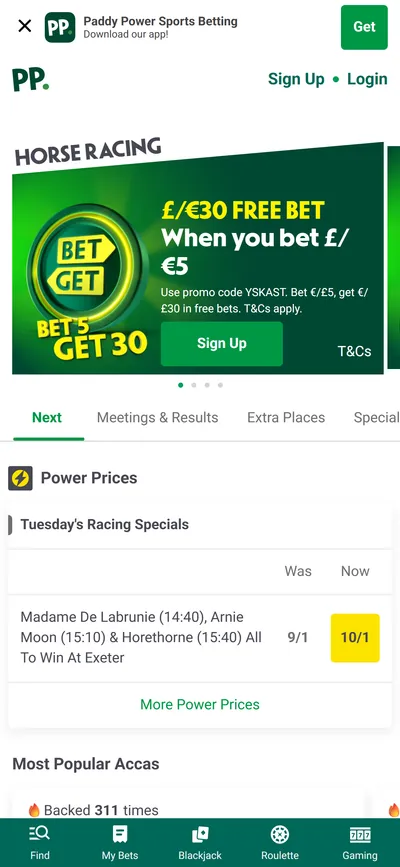
- Social proof on betting content is rare and inconsistently applied. Only Paddy Power and Betfair explicitly surface "backed X times" signals on accumulator and multi-bet content — Betfair with specific counts (e.g. "33 Times Backed", "22 Times Backed") on Popular Racing Multis.
---
Detailed Analysis
Personalisation depth is minimal across the board. With session_expired flagged on the sole logged-in Bet365 capture, this dataset cannot support any conclusions about how the industry handles authenticated personalisation — recommendations, recent activity, or personalised promotional targeting. What can be observed is that logged-out personalisation is also largely absent: 15 of 18 usable sites serve entirely static content with no segmentation signals whatsoever. The two exceptions worth noting are 888sport, whose banner slider component exposes segmentation parameters in its markup (VIP status, first-time deposit flag, country, currency, and promotion permission flags), suggesting a segmentation framework exists even if it rendered no visibly different content at capture time; and ESPN, which surfaces a favourites carousel for logged-out users with a prompt to sign in to manage preferences — a lightweight personalisation hook that doesn't require authentication to display.
Logged-out conversion approaches vary significantly in ambition. The most content-rich logged-out experiences are Bet365 (8 content blocks including Bet Builder player markets and live scores), William Hill (8 blocks including a Storyly interactive stories widget with 9 story groups), and Paddy Power (6 blocks with actual betting content, social proof on accumulators, and a live racing strip). These sites treat logged-out users as prospective bettors and serve substantial product content alongside their welcome offers. At the other extreme, Coral's entire site — homepage, football page, and racing page — redirected to a Football Super Series quiz splash page gating access behind a login prompt. Betway's capture shows only a welcome offer carousel and a sponsorship section, with no betting content visible at all. Sky Bet's football and racing pages served registration forms directly rather than sport content, which represents an aggressive funnel-first approach but offers nothing to a user who hasn't yet decided to register.
Social proof and urgency signals are used sparingly and inconsistently. William Hill's Storyly widget is the standout example of dynamic, story-format engagement content — 9 interactive story groups covering specific boosts, promotions, and events. This is the only example in the dataset of a narrative-style engagement layer. Paddy Power's racing page shows accumulator backing counts ("backed X times") on its Most Popular Accas carousel, and Betfair's racing page does the same with specific numerical counts on Popular Racing Multis. Sky Bet surfaces a single Bumper Boost with a specific horse name and race time, creating a time-bound urgency signal. Midnite leads with a "SUPER BOOST" hero block naming specific players and showing a before/after odds movement (WAS 4/9, NOW 7/4). These urgency and social proof signals are applied to individual features rather than as a systematic design approach across any single site.
CTA volume and placement vary considerably. Betfair's homepage surfaces 4 distinct sign-up/login oriented CTAs ("Sign Up", "Login", "Join Today", "Join the action"). DraftKings uses "LOG IN | SIGN UP" as a single combined CTA, plus repeated "Log in" prompts across its loyalty and social sections — 3 distinct login/signup touch points on one page. Coral, despite gating content, also surfaces 3 auth CTAs ("Join", "LOG IN", "Log in to play"). Betway surfaces 3 ("Join", "Login", "Sign up"). Most other sites use a standard 2-CTA header pattern (login + register). William Hill and Paddy Power both add app download banners as a third conversion path, treating app install as an alternative to web registration rather than a complementary action.
The non-betting benchmarks (Netflix, Spotify, Revolut, Deliveroo) show contrast worth noting. Netflix commits its entire logged-out homepage to a single email-capture conversion goal with no competing calls to action. Revolut leads with quantified social proof ("70+ million customers", "4.7/5 on Trustpilot", "#3 most downloaded finance app") before any product detail — a trust-first rather than offer-first approach. Spotify's conversion hook is a time-limited free trial (1 month at £0) with a single clear CTA. Deliveroo gates its core product utility (browsing restaurants) behind a postcode input, using functional value as the conversion mechanism. None of the betting sites in this dataset take a comparable trust-first or utility-first approach to their logged-out experience — the sector defaults to leading with the welcome offer quantum.


---
Implications for BoyleSports
- BoyleSports had no usable capture data (recorded as blank), so it is not possible to assess which of these patterns it already exhibits or where specific gaps exist. The observations below should be validated against BoyleSports' current product before treating them as actionable gaps.
- The absence of social proof on accumulator and multi content is a notable gap across the industry. Only Paddy Power and Betfair apply "backed X times" signals to pre-built accumulators and multis. If BoyleSports does not currently surface backing counts or popularity signals on its ACCA or Bet Builder content, this is a relatively low-complexity pattern that two direct competitors are already using — worth assessing whether the data exists to support it.
- William Hill's Storyly interactive stories widget is the only example of a story-format engagement layer in the dataset. It serves as a dynamic, swipeable content surface for promotions and boosts that sits above standard carousel patterns. If BoyleSports' current promotional surface is a static or sliding banner, this represents a structural difference in how at least one competitor is presenting time-sensitive offers on mobile — though there is no performance data here to indicate whether this format drives materially different outcomes.

Previous Weeks
Analysis failed: [WinError 206] The filename or extension is too long...
Key Takeaways Only 1 of 19 analysable sites (Bet365) was successfully captured logged-in, with its session expired, preventing any meaningful assessment of logged-in personalisation across the industry Bet365 leads promotional density with 8 distinct offers on its logged-out homepage, compared to ju...
Key Takeaways Bet365 shows zero personalisation even when logged in - both logged-out and logged-in captures display identical promotional carousels and content blocks, suggesting personalisation occurs deeper in the funnel rather than on the homepage William Hill employs Instagram-style story carou...